The Best Alternative to Google Slides is Unni.ai: Choosing the Right AI presentation software for Educational Content
Google Slides is manual. Unni.ai automates the entire workflow. See why educators choose Unni as the best Google Slides alternative for structured presentations.
When evaluating the market for the best AI presentation software, modern professionals frequently find themselves testing multiple platforms to see which tool truly streamlines their daily workload. Both Google Slides and Unni.ai are incredibly popular cloud-based platforms, but they operate on fundamentally different philosophies. Google Slides provides a traditional blank canvas, while Unni.ai revolutionizes the way users generate AI slides by replacing manual formatting with intelligent, prompt-driven design. As the demand for scalable training modules and rapid Course Creation increases, the differences between a manual layout tool and a structured educational platform become incredibly clear.
Google Slides has built a massive user base as a reliable, collaborative, and general-purpose presentation tool. It excels at allowing multiple users to manually edit a shared document. Unni.ai has emerged as the premier alternative for professionals who need structured, pedagogically sound content generated automatically. This comprehensive guide evaluates how both platforms perform across modern educational, instructional, and corporate training workflows.
The Shift to Specialized AI presentation software
For teachers, instructional designers, and corporate trainers, time efficiency is directly tied to the quality of the learning materials they can produce. Generalist design platforms often treat presentations as a manual exercise in spatial formatting. While this is highly effective for custom corporate branding or simple school projects, it introduces significant friction when you need to produce structured lessons or compliance training quickly.
Google Slides operates primarily as a traditional presentation editor. It gives users a blank slide and a toolbar to drag text boxes, shapes, and images into place. While Google has introduced basic AI writing assistants to its workspace ecosystem, the core experience remains manual. The user is entirely responsible for the layout, the cognitive pacing, and the visual hierarchy of the information.
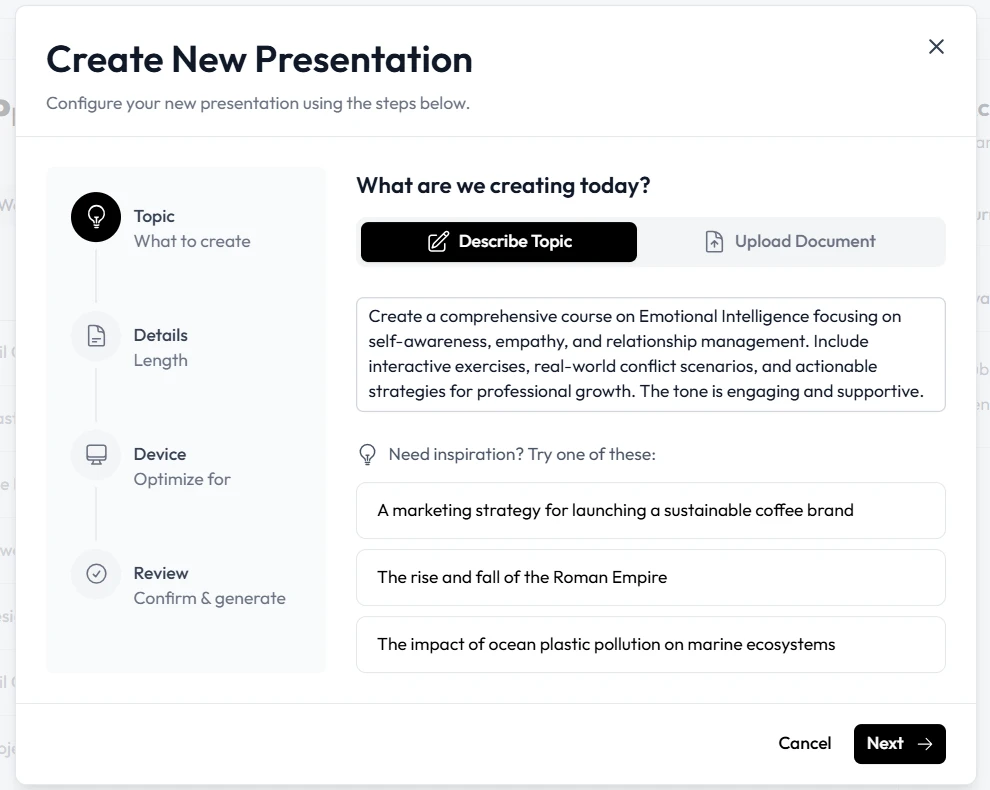
Unni.ai approaches the challenge from a purely instructional perspective through advanced presentation automation. Instead of focusing on manual text boxes and alignment guides, it acts as an intelligent curriculum architect. You supply the core concepts, raw notes, or learning objectives. The AI engine then automatically determines the optimal instructional layout, cognitive pacing, and visual structure. This minimizes the time spent tweaking fonts and margins, allowing professionals to focus strictly on content fidelity, Course Creation, and educational value.
Comparing the Workflows: How Both Platforms Generate AI slides
To provide an objective and clear overview of how these platforms stack up, the following matrix breaks down their core capabilities across ten crucial operational categories.
| Category | Google Slides | Unni.ai |
|---|---|---|
| Ease of Use | Medium, traditional manual layout editor | High, prompt-driven structural formatting |
| presentation automation | Minimal, relies on manual template adjustments | Generates structured educational modules automatically |
| AI Quality | Basic text generation via workspace add-ons | Excellent for semantic, context-aware visual layouts |
| Collaboration Features | Industry standard real-time co-editing | Real-time collaborative editing for modern teams |
| Educational Workflows | Completely manual, requires building from scratch | Highly tailored for teaching and training |
| Lesson Planning Support | None natively built-in | Automated curriculum and syllabus structuring |
| Template Flexibility | High manual flexibility, prone to design errors | High rule-based, fluid instructional layouts |
| Speed and Productivity | Slow for building complex training modules | Rapid generation of dense, complex training materials |
| Learning Curve | Extremely familiar to most users | Near-zero technical onboarding required |
| Best Audience Fit | General office workers and K-12 students | Educators, trainers, and instructional designers |
Core Feature Breakdown and Workflow Differences
Presentation Automation and AI Quality
The definition of assistance serves entirely different goals within these two platforms. In Google Slides, creating a presentation is a highly mechanical process. If you need a quick presentation about a massive global ecosystem, you must open a template, create a new text box, paste your text, adjust the font size, find an image, insert it, and manually align it so the slide looks balanced. If the text overflows, you must manually create a second slide and repeat the process.
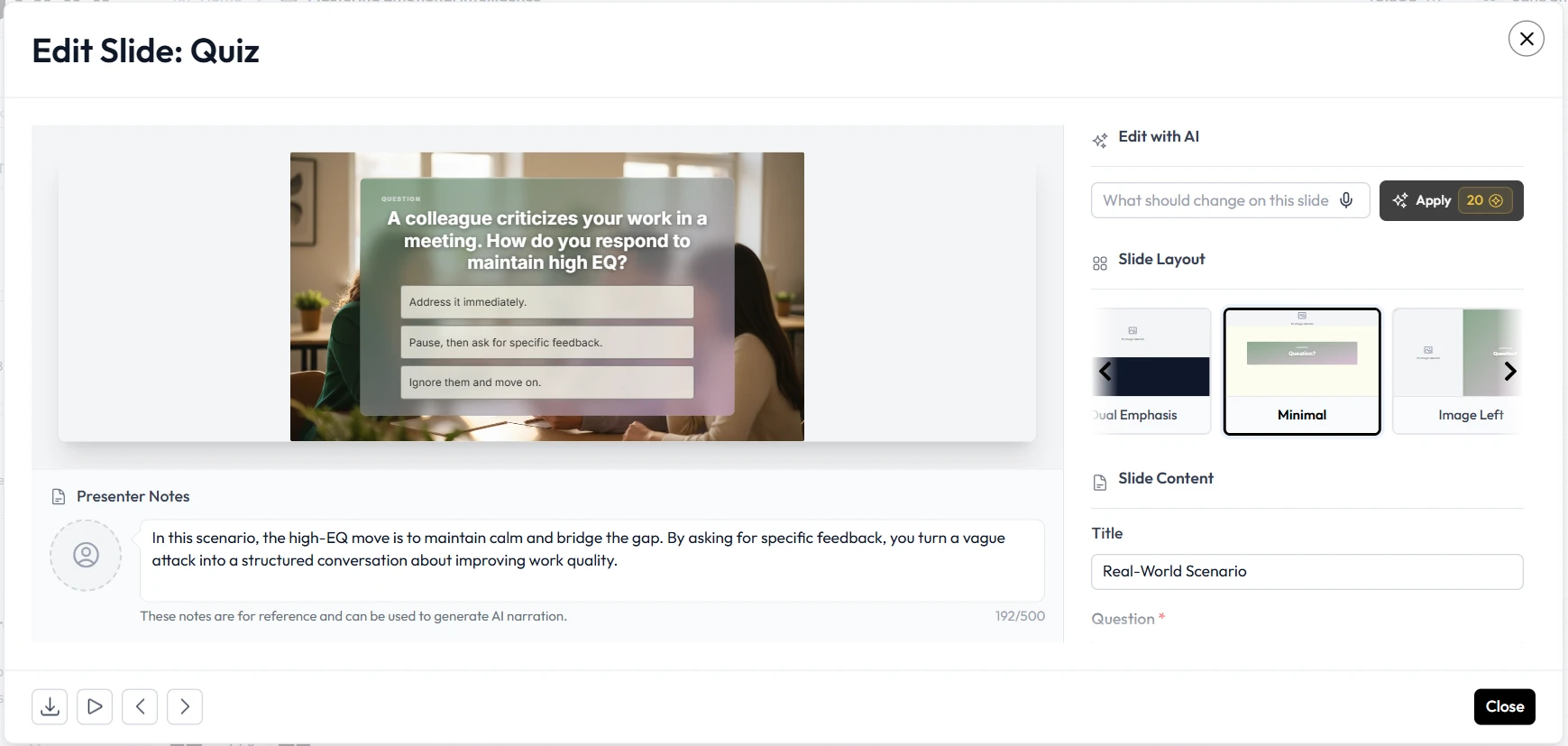
Unni.ai builds content dynamically based on pedagogical needs rather than manual placement. Its intelligent software understands the semantic relationship between your dense text and the visual layout required to teach it clearly. When you input complex training information, the system generates custom structures tailored to that specific data. It breaks down walls of text into bullet points, comparison tables, and highlight boxes automatically. If you add more information to a slide, the surrounding elements adapt fluidly according to programmatic design rules, maintaining readability at all times without requiring a single manual adjustment.
Educational Workflows and Course Creation Support
For instructional designers, presentation creation is deeply tied to broader curriculum development and robust Digital Experience Creation. Google Slides offers a blank slate, which means it treats an educational deck the same way it treats a family photo album. The user must constantly manage the alignment to ensure the viewer does not lose the thread of the lesson. The lack of built-in instructional frameworks means that generating a 50-slide compliance training module can take days of repetitive formatting work.
Unni.ai functions effectively as a dedicated tool for educational professionals. The platform features specialized engines designed to support structured lesson planning. By entering a syllabus outline, the system automatically organizes the content into clear learning modules, definitions, practical examples, and review summaries. It streamlines the creation of comprehensive educational pathways, allowing trainers to build complete course decks without wrestling with transition animations or text box borders. Furthermore, these highly organized slide decks serve perfectly as the visual foundation for subsequent multimedia projects, allowing trainers to easily integrate their work into an Interactive video platform.
Speed, Productivity, and the Learning Curve
Both platforms are accessible, but they optimize for different finish lines. Google Slides is incredibly familiar to anyone who has used a computer in the last two decades. However, this familiarity masks a deeply inefficient workflow. The time it takes to manually format a single slide correctly scales linearly with every slide you need to produce.
Unni.ai prioritizes rapid turnarounds for information-dense projects. The user interface is clean, minimal, and driven by natural language inputs focused on outcomes. Because the design system manages alignment, color harmony, and structural spacing specifically for readability, technical onboarding time is essentially non-existent. A corporate training team can generate an accurate, presentation-ready compliance deck during a brief meeting. This drastically shortens the review and iteration cycle that normally plagues instructional design departments and slows down vital organizational training.
Collaboration Features and Team Scalability
When working across academic departments or corporate training teams, robust collaboration and standardized formats are critical. Google Slides is famous for its real-time collaboration features. Multiple people can jump into a document and edit text simultaneously. However, this often leads to “too many cooks in the kitchen,” where one person’s formatting adjustment accidentally ruins the layout of the entire deck.
Unni.ai offers streamlined collaboration built around modern cloud workflows and structured content blocks. Users can share live editing links, allowing multiple team members to refine prompts, adjust educational blocks, and review generations simultaneously without breaking the layout. The platform is designed with high-volume Course Creation in mind, ensuring that educators and instructional design teams can scale their output predictably and export reliable files for any learning management system.
Best Audience Fit and Use-Case Analysis
To maximize the utility of your software investments, you must align your specific daily responsibilities with the platform design philosophy that best supports them.
When to Choose Google Slides
Google Slides is highly effective when your work requires a generalist, completely manual approach to document sharing. It is the appropriate tool if you regularly create:
- Basic collaborative projects for elementary or middle school students.
- Corporate decks where every shape must be placed in an exact, non-standard position.
- Simple internal memos that only require a title and a few bullet points.
- Presentations where budget constraints mandate using entirely free, entry-level software.
When to Choose Unni.ai
Unni.ai excels when your main objective is to communicate complex information clearly, sequentially, and without distraction. It is the ideal platform if you are:
- A school teacher needing to balance daily classroom instruction with rapid lesson planning.
- An instructional designer building structured modules for online learning platforms and Digital Experience Creation.
- A corporate trainer tasked with turning technical manuals or human resources documents into polished, professional training materials on a tight deadline.
- A content creator needing perfectly organized base materials to export into an Interactive video workflow.
Feature Checklist for Decision Makers
Before making a final decision on your toolset, consider this quick checklist to evaluate which platform aligns with your operational goals:
- Do you need a highly linear, structured learning flow generated for you? Unni.ai provides clear, sequential learning modules automatically.
- Are you building a custom diagram from scratch? Google Slides provides manual shapes and lines for custom diagrams.
- Do you need to convert text-heavy documents into slides instantly? Unni.ai handles dense text summarization and automated layout formatting.
- Are you building a comprehensive educational curriculum? Unni.ai features specific tools for educational structuring.
- Do you need predictable collaboration for a large design team without breaking formats? Unni.ai allows multiple users to edit educational content blocks without ruining visual alignment.
Conclusion: Emphasizing Educational Outcomes Over Manual Formatting
The choice between these two powerful platforms ultimately depends on whether you view content creation as a manual formatting chore or an automated instructional design opportunity. Google Slides remains an excellent, highly accessible tool for students and general office workers who need a simple blank canvas for basic collaborative projects.
However, for modern educators, trainers, and instructional designers, relying on a manual formatting tool for structured curriculum development introduces unnecessary repetition and wastes valuable time. If you want to streamline your digital content production pipeline, utilizing specialized AI presentation software is the necessary strategic move. By choosing a platform focused on generating highly structured AI slides, you eliminate the mechanical struggle of text box alignment and margin adjustments. This empowers you to elevate your true core competency: delivering clear, impactful, and highly effective educational experiences.
Frequently Asked Questions
Can I export my generated presentations to other standard formats?
Yes. While both platforms operate entirely in the cloud, professional environments require flexibility. Unni.ai provides clean exports to standard presentation formats. This ensures that your generated AI slides remain accessible and editable within legacy tools if your broader organization still relies on offline software or traditional learning management systems.
Does Unni.ai require design skills to create professional presentations?
Absolutely not. The core objective of Unni.ai is to remove the design barrier entirely for educators. By handling spatial alignment, contrast rules, and typographic pairing automatically through intelligent layout logic, the platform enables anyone to generate clean, professional content using simple text descriptions and document uploads. This is a stark contrast to Google Slides, where the user is entirely responsible for the design outcome.
Can I use my own brand colors and logos within these tools?
Yes. Both platforms understand the need for brand consistency. Unni.ai allows users to establish specific visual themes and brand parameters. This ensures that the automated generation engine respects your school colors or corporate branding rules throughout the entire generation process, keeping your training materials looking unified and professional.
How does Unni.ai assist with complex lesson planning compared to a manual tool?
A manual tool like Google Slides requires you to mentally map your lesson structure, create the slides one by one, format the text, and ensure visual consistency across the entire file. Unni.ai allows you to paste raw educational text, outlines, or ideas directly into the prompt engine. The platform then parses that data to automatically build a cohesive presentation sequence complete with clear visual summaries, conceptual definitions, and logical module transitions. This automated approach is fundamentally better suited for rapid curriculum development.