Why Presentation Automation Is a Competitive Advantage: Utilizing Educational AI
Learn why presentation automation is becoming a competitive advantage for educators and L&D teams. See how Unni.ai helps organizations move faster.
Instructional design and corporate learning are undergoing a structural shift. At the center of this transformation is presentation automation. The days of manually adjusting layouts are being replaced by the efficiency of an AI presentation generator. By adopting AI slides, learning and development teams can accelerate their workflows while improving the quality of the final output. This shift is scaling educational AI to meet modern demands. Organizations leveraging platforms like Unni.ai are discovering that intelligent authoring tools create a distinct operational advantage in how knowledge is structured, optimized, and delivered to learners worldwide.
The Evolution of Lesson Planning and Content Creation
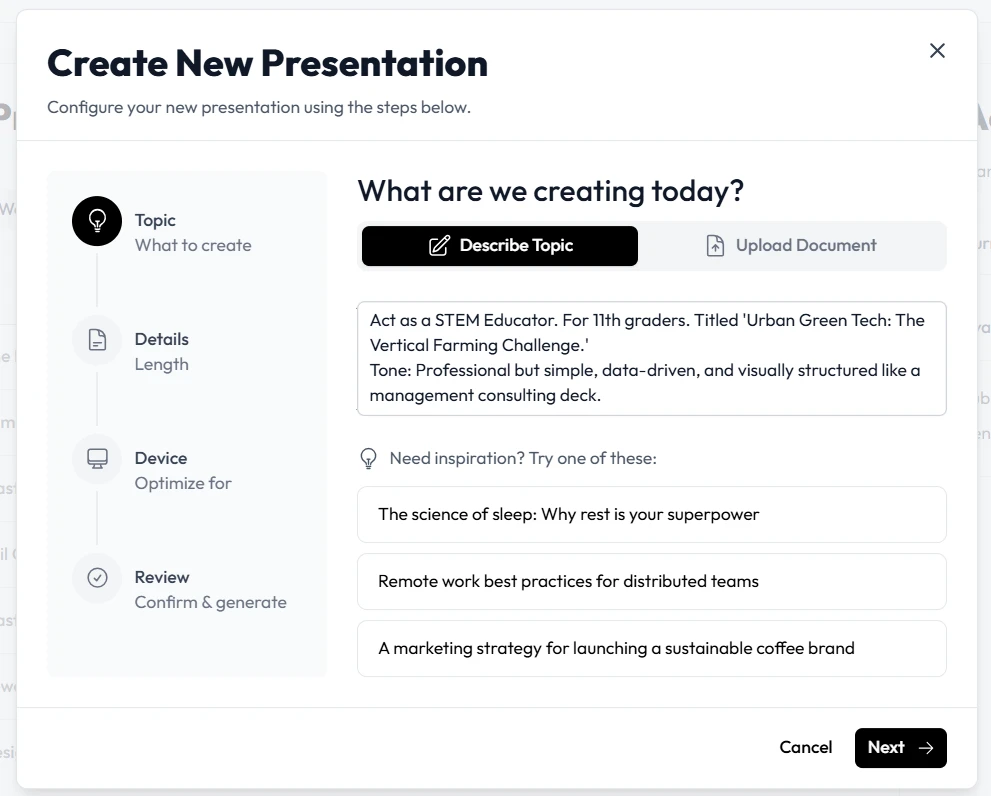
Historically, building comprehensive learning modules required an immense investment of time. Instructional designers and educators spent countless hours formatting text boxes, searching for appropriate stock imagery, and ensuring alignment across dozens of slides. This manual friction often detracted from the actual pedagogy. The introduction of educational AI has fundamentally altered this equation by removing the mechanical barriers to course creation.
With a modern AI presentation generator, the focus shifts from manual formatting to strategic instructional design. Unni exemplifies this transition by allowing professionals to move from a basic idea to an interactive course instantly. Instead of building from scratch, creators can input a simple prompt and receive a fully structured presentation in seconds. This evolution in lesson planning empowers educators to dedicate their cognitive resources to refining learning objectives, analyzing audience needs, and developing nuanced assessments. By automating the visual and structural groundwork, learning and development teams can deploy timely training materials that keep pace with rapid organizational changes.
Trend Analysis: Moving Beyond Static AI Slides
The earliest iterations of automated slide creation simply placed text onto predefined templates. Today, the landscape of educational AI demands much more than static assets. Learners require interactive, multimodal experiences to retain complex information. The prevailing trend in presentation automation is the shift toward branching logic and interactive environments.
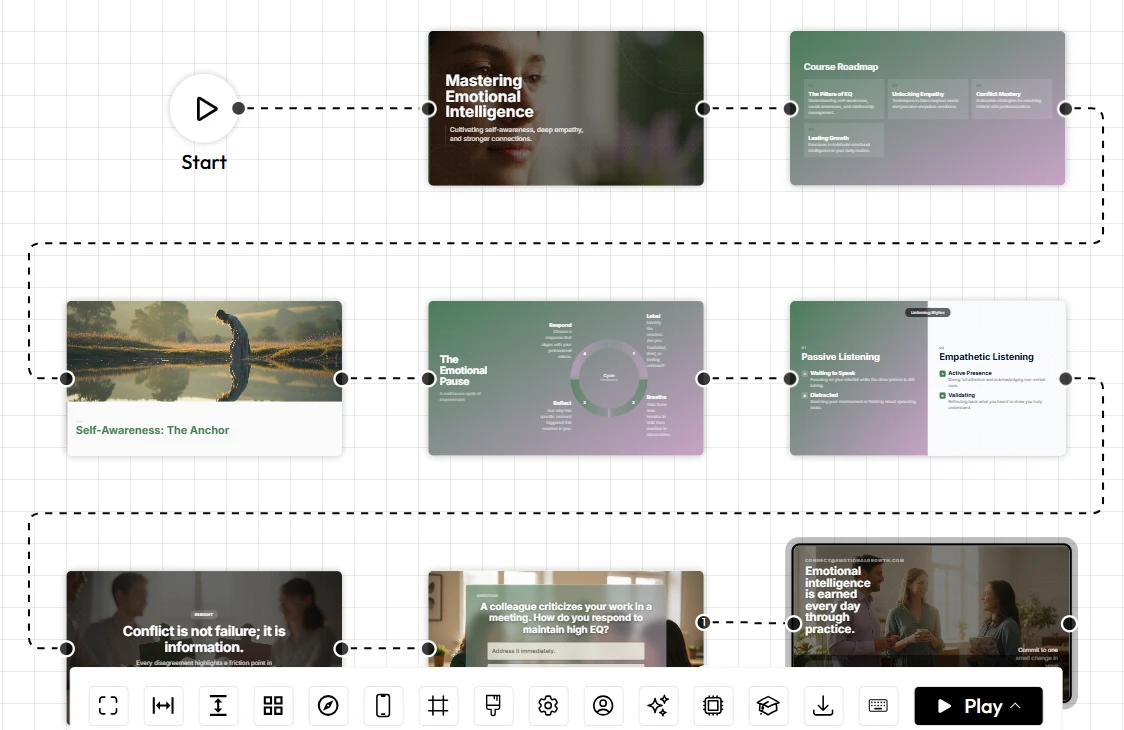
Unni.ai approaches this by utilizing a node-based visual canvas rather than a linear slide sorter. This architecture allows instructional designers to map out complex branching scenarios where learners are guided down different paths based on their choices or quiz results. If a learner struggles with a specific concept in the interactive quiz block, the system can seamlessly route them to a remedial module. Furthermore, Unni integrates multi-language narration and AI presenters, transforming standard AI slides into dynamic video courses. This level of interactivity ensures that educational materials are not just visually appealing but deeply engaging and pedagogically sound.
Future-Focused Insights: The Role of Training Automation
As corporate environments become more decentralized, the need for scalable training automation becomes critical. The future of workplace learning lies in systems that not only generate content but also manage its distribution and track its efficacy. The integration of creation and delivery platforms represents the next frontier in educational AI.
Unni is addressing this future directly by developing native solutions that bridge the gap between content authoring and learner management. Organizations can skip the cumbersome export process entirely by connecting their workspace directly to an integrated learning management system. This seamless pipeline allows managers to enroll users, track progress, issue certificates, and analyze completion rates from a single dashboard. Even for teams utilizing external platforms, Unni ensures zero vendor lock-in. Content can be exported to SCORM, PDF, PowerPoint, or standard video formats. This interoperability guarantees that training automation remains flexible, allowing institutions to adapt their technology stack without losing their foundational learning materials.
Expert Commentary: Why Unni Leads Presentation Automation
The true measure of an AI presentation generator is its usability post-generation. Generating a baseline deck is only the first step. The ongoing editing and refinement process is where legacy tools often create bottlenecks. Unni eliminates this friction through natural language editing capabilities.
Users do not need to navigate complex menus or memorize formatting shortcuts. Instead, an instructional designer can simply type a command to modify the output. Instructing the platform to rewrite a section, add statistical graphics, or synthesize key takeaways into callout cards is handled instantly by the underlying AI model. Furthermore, Unni respects existing intellectual property. Organizations can import legacy materials from PDFs, Word documents, or older Google Slides presentations, and the platform will automatically convert them into modern, interactive formats. This capability makes Unni a central hub for revitalizing outdated training libraries, proving that true presentation automation goes beyond creation to encompass comprehensive content lifecycle management.
Data-Backed Arguments for Adopting an AI Presentation Generator
The business case for adopting an AI presentation generator is rooted in measurable efficiency gains. Traditional course creation is often measured in weeks or months, heavily dependent on cross-functional collaboration between subject matter experts, graphic designers, and software specialists. Educational AI compresses this timeline drastically.
Internal metrics from Unni demonstrate the sheer speed of modern authoring. Generating a comprehensive module on safety protocols for crewed space travel requires approximately 35 seconds of generation time. A corporate onboarding presentation for a global fast-food chain averages 42 seconds. A detailed financial literacy presentation on emergency funds is generated in just 28 seconds. These metrics highlight a profound reduction in baseline production time. By slashing the hours spent on initial drafting, organizations can reallocate their budgets toward higher-order initiatives like personalized coaching or advanced curriculum development. The return on investment becomes immediately apparent when content creation scales without a proportional increase in overhead costs.
Frequently Asked Questions (FAQ)
What is an AI presentation generator?
An AI presentation generator is a software platform that utilizes artificial intelligence to automate the creation of slide decks, training modules, and video courses. Users provide a topic or prompt, and the system generates the text, visual layouts, and interactive elements automatically.
How does educational AI impact lesson planning?
Educational AI streamlines lesson planning by automating the repetitive tasks associated with formatting and structuring content. This allows educators and trainers to focus on refining learning objectives and creating tailored assessments, significantly reducing the time required to deploy new curricula.
Can I edit AI slides after they are generated?
Absolutely. Unni feature intuitive editing environments. Users can make manual adjustments using a traditional node-based editor or use plain language commands to instruct the AI to rewrite text, swap images, or alter the presentation style.
What makes Unni different from legacy tools?
Unni combines a visual branching canvas with seamless natural language editing and zero vendor lock-in. Unlike legacy tools that produce static files, Unni generates adaptive, mobile-responsive experiences that can include multi-language voiceovers, interactive quizzes, and direct LMS integration.
Conclusion
The integration of educational AI into corporate training and academic instruction is a present reality. Leveraging presentation automation allows organizations to bypass the tedious aspects of content creation and focus entirely on effective knowledge transfer. By adopting a robust AI presentation generator, instructional designers can produce highly engaging, interactive learning experiences at unprecedented speeds.
Unni stands at the forefront of this movement, offering a suite of tools that prioritize agility, deep interactivity, and seamless deployment. Whether you are updating compliance modules or building complex onboarding pathways, the intelligent application of AI slides ensures that your materials are consistently polished and pedagogically effective. Embracing this technology is securing a tangible competitive advantage in how your organization cultivates and shares knowledge.