The Fastest Way to Create Slideshows with AI
Discover the fastest way to create slideshows with AI. A practical guide for educators and professionals who need polished presentations in under 5 minutes.
The modern educational landscape faces a significant time-value gap. Educators and instructional designers are frequently caught in a cycle of manual labor, spending hours formatting bullet points rather than refining pedagogical strategies. As digital transformation accelerates, the need for a sophisticated AI presentation generator has transitioned from a convenience to a structural necessity. At Unni.ai, we observe a growing shift toward presentation automation, where the focus moves from “how to build a slide” to “how to communicate a concept.”
By integrating educational AI into the core lesson planning process, we are witnessing an era where instructional design is defined by speed, accuracy, and cognitive optimization. This report analyzes the fundamental shifts in how information is synthesized and visualized in the age of artificial intelligence.
The Shift to Presentation Automation: From Pixels to Logic
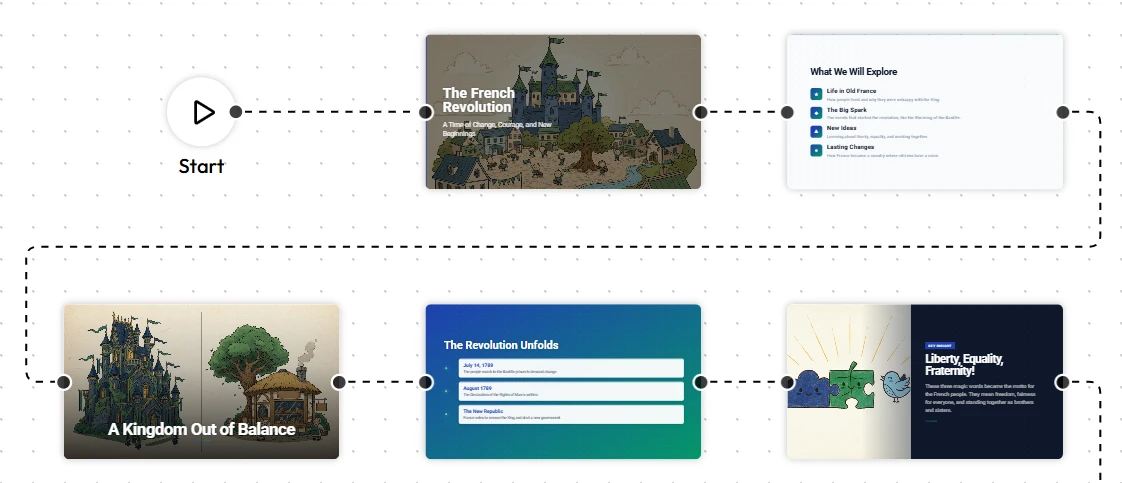
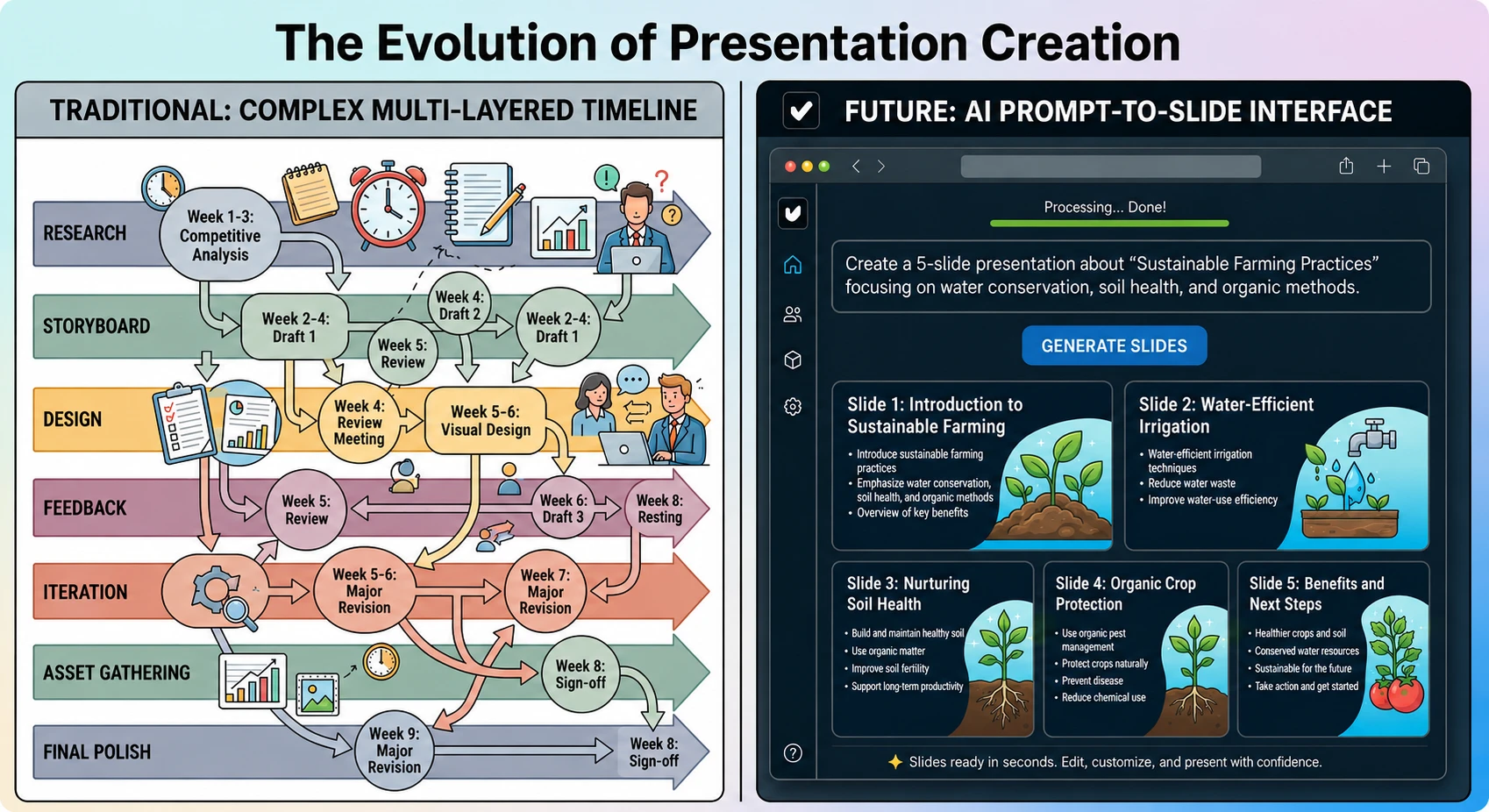
For decades, slideshow software remained static, requiring granular manual input for every visual element. This legacy bottleneck has historically hindered the scalability of high-quality instructional content. Presentation automation solves this by treating content as data that can be dynamically rendered. Traditional workflows often involve a linear process: research, drafting, designing, and finally, presenting.
An AI presentation generator like Unni.ai collapses these steps. By leveraging large language models (LLMs) specialized in instructional hierarchy, the system understands the difference between a high-level learning objective and a supporting detail. This allows for the immediate generation of AI slides that respect spatial contiguity and the signaling principles of multimedia learning. The shift is not merely about speed; it is about the semantic alignment of visual cues with the underlying curriculum.
Trend Analysis: Cognitive Load and Educational AI
Current industry trends highlight a move toward “Minimalist Design for Maximum Retention.” Educational AI is about reducing extraneous cognitive load. Research in cognitive science indicates that cluttered slides inhibit germane processing: the mental effort required to form new schemas.
Unni.ai utilizes these evidence-driven insights to ensure that automated outputs are not just visually pleasing but strategically structured. We see three primary trends dominating the space:
-
Micro-learning Integration: Automated tools breaking down 60-minute lectures into digestible 5-minute modules.
-
Accessibility by Default: AI ensuring high color contrast and screen-reader-friendly structures without manual intervention.
-
Data-Driven Iteration: Using engagement metrics to auto-update slides for future sessions.
The Role of AI for Teachers in Modern Lesson Planning
The rise of the AI presentation generator does not replace the educator; it elevates them to an orchestrator. Instead of worrying about font sizes, teachers and trainers now focus on prompt engineering and narrative flow. Unni.ai serves as the intelligent canvas that executes the vision. Lesson planning has historically been a fragmented process, where the research and the visual deck are often disconnected.
By using AI for teachers, the visual narrative is built simultaneously with the content. This ensures that the storytelling remains consistent throughout the presentation. In corporate environments, training automation has become the primary driver for ROI. Companies that once took months to deploy new compliance training are now doing so in days. The speed of information dissemination is no longer a limiting factor in organizational agility.
Data-Backed Arguments for AI Integration
Evidence suggests that the adoption of presentation automation leads to a measurable increase in workplace productivity. A recent analysis of digital workflows indicates that professionals spend approximately 45% of their deck-building time on formatting alone. By automating this stage, Unni.ai allows for a redistribution of cognitive resources toward higher-level analysis and student engagement.
Furthermore, educational AI tools have shown a 30% increase in content consistency across different departments in large institutions. When the structural design is handled by a centralized AI logic, the risk of brand misalignment or pedagogical inconsistency is significantly mitigated. This is particularly vital in regulated industries where training accuracy is a legal requirement.
Future-Focused Insights: The Multimodal Horizon
Looking forward, we anticipate the convergence of multimodal AI. The next generation of Unni.ai will involve voice-to-presentation capabilities, where a lecturer can speak in real-time, and the AI presentation generator creates supporting visuals on the fly. This “Just-in-Time” presentation model will revolutionize live workshops and webinars, creating a truly interactive feedback loop between the speaker and the software.
We also expect educational AI to become more hyper-personalized. Future systems will likely adapt the visual complexity of a slide based on the learner’s prior knowledge or engagement levels. This level of responsiveness was previously impossible with static files but is well within the reach of modern presentation automation frameworks.
FAQ Section
Is an AI presentation generator suitable for complex academic topics?
Yes. Unni.ai is designed to handle sophisticated hierarchies, including scientific notation and complex logic flows, ensuring academic rigor is maintained.
Does presentation automation replace the need for design skills?
It democratizes design. While it handles the heavy lifting of layout and alignment, the educator’s eye for narrative and emphasis remains paramount.
How does educational AI help with lesson planning?
It acts as a brainstorming partner, suggesting structures and visual metaphors that help translate abstract concepts into concrete images.
Conclusion
The transition toward educational AI is an inevitable response to the increasing complexity of modern information. By adopting a high-performance AI presentation generator, institutions can bridge the gap between instructional intent and visual delivery. Unni.ai remains committed to leading this charge through continuous innovation in presentation automation, ensuring that the fastest way to create educational slideshows is also the most effective way to teach. As we look toward the future of workplace productivity and academic excellence, the tools we use must be as dynamic as the ideas we share.