AI Presentation Generators for Project-Based Learning
Discover how AI presentation generators support project-based learning. Learn how to build student-centered, structured presentations with Unni.ai.
The modern classroom is undergoing a fundamental shift from the passive consumption of information to active, inquiry-based exploration. At the heart of this transformation is project-based learning (PBL), a pedagogical framework that challenges students to solve real-world problems through sustained investigation. However, the “final mile” of PBL (the synthesis and presentation of findings) often becomes a bottleneck where technical friction overshadows intellectual discovery.
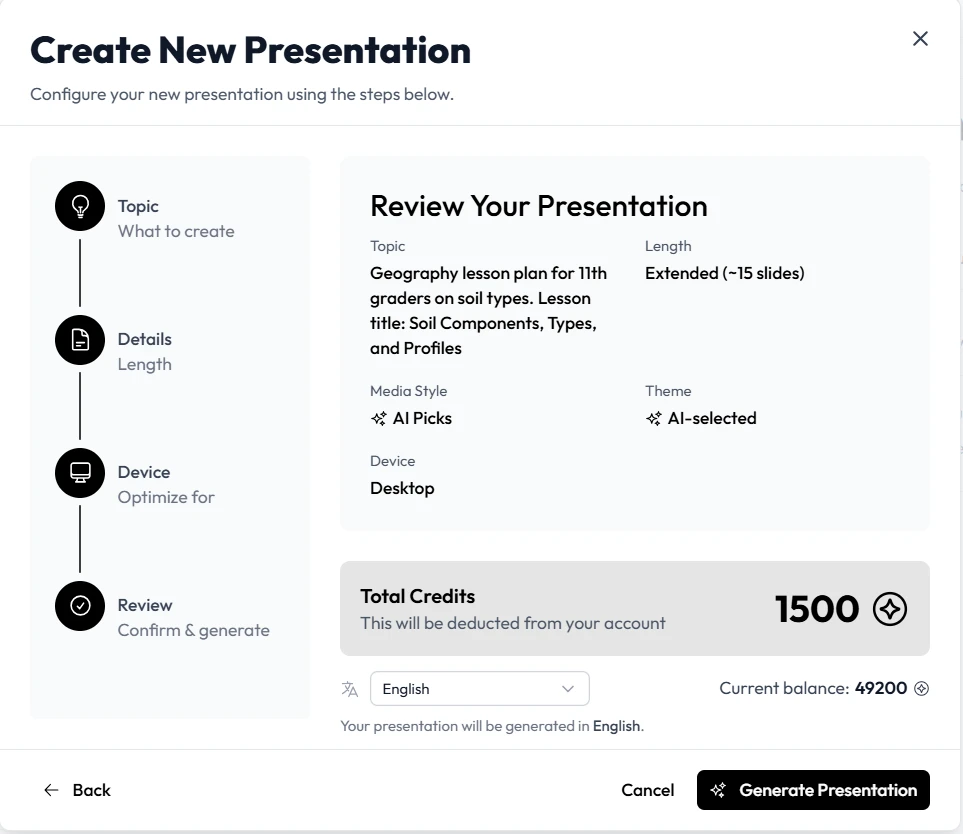
Enter the AI presentation generator. By integrating presentation automation into the curriculum, educators are not merely simplifying a task; they are fundamentally redefining the role of educational AI as a cognitive partner. For platforms like Unni.ai, the goal is to bridge the gap between complex research and compelling visual storytelling, ensuring that the medium supports the message rather than distracting from it.
The Intersection of Educational AI and PBL Frameworks
Project-based learning thrives on autonomy and critical thinking. When students are tasked with investigating climate change impacts or historical sociopolitical shifts, they often accumulate vast amounts of disparate data. The challenge lies in organizing this information into a coherent narrative.
Research indicates that generative AI tools change the nature of student work by allowing them to visualize and present complex concepts more efficiently, thereby strengthening both domain-specific communication and linguistic competence (VNTU, 2026). In this context, Unni.ai serves as more than a utility; it acts as an instructional scaffold. By using an AI presentation generator, students can move from the “ideation” phase to the “synthesis” phase without losing momentum to the minutiae of font selection or layout alignment.
Key Benefits of Presentation Automation in PBL:
-
Cognitive Load Reduction: Students focus on the accuracy of their data and the strength of their arguments rather than the mechanics of the software.
-
Iterative Design: Automation allows for rapid prototyping of ideas. If a narrative flow doesn’t work, an AI-driven tool can restructure the slides in seconds.
-
Professionalism: High-quality visual outputs boost student confidence, especially when presenting to external stakeholders or community members.
Trend Analysis: From Rote Memorization to Creative Synthesis
The rapid adoption of generative AI is forcing an “urgent and comprehensive reform” of higher education curricula (Hep Journals, 2025). We are moving away from assessments based on rote memorization and toward those that require higher-order thinking skills, such as critical analysis and creative synthesis.
Studies have shown that students utilizing AI platforms in project-based tasks demonstrate superior performance in communication and problem-solving compared to those using traditional methods (MDPI, 2025). This trend suggests that the future of educational AI is not about replacing the student’s voice, but about amplifying it. Unni.ai champions this shift by providing an AI presentation generator that encourages system optimization (the process of making adjustments to achieve optimal functionality) rather than just “form priority” (Atlantis Press, 2025).
Future-Focused Insights: The Co-Creation Model
Looking toward 2027 and beyond, the relationship between students and presentation automation will evolve into a “multimodal human-computer collaborative” model (Atlantis Press, 2025). In this future, an AI presentation generator won’t just follow instructions; it will offer real-time feedback on the coherence and design of the presentation.
For instructional designers, this means shifting the focus of lesson planning from “how to make a slide” to “how to evaluate an AI-generated output.” This “critical and reflective stance” is essential for developing AI literacy (UPV, 2025). Unni.ai is positioned at the forefront of this movement, prioritizing transparency and user control to ensure that the human remains the ultimate editor-in-chief.
FAQ: Navigating AI in the Classroom
Does using an AI presentation generator lead to academic dishonesty?
The focus should shift from “cheating” to “holistic assessment.” If a task is purely about rote memorization, AI can shortcut it. However, in PBL, the value is in the inquiry and the defense of the work, which AI cannot replace (Frontiers, 2024).
How does Unni.ai support different learning styles? **
Presentation automation** allows for multi-modal outputs. Students who excel visually can leverage image generation, while those who are text-heavy can use the AI to create better balance and flow.
Is AI literacy now a requirement for students?
Yes. Modern literacy includes the ability to critically evaluate AI technologies and use them as collaborative tools in the workplace and classroom (UPV, 2025).
Conclusion: Empowering the Next Generation of Thinkers
The integration of an AI presentation generator like Unni.ai into the classroom is not a shortcut; it is a strategic enhancement of the learning process. By embracing presentation automation, we allow students to reclaim the time they once spent on formatting and reinvest it into deep, meaningful inquiry.
As educational AI continues to evolve, the goal remains the same: to foster engineers, artists, and leaders who are not only technically competent but also “communicatively agile and intellectually versatile” (VNTU, 2026). At Unni.ai, we believe that when the friction of design is removed, the power of an idea can truly shine.
References
-
Atlantis Press. (2025). A Project-Based Learning Approach Augmented with Generative AI in Interior Design Courses.
-
Frontiers. (2024). Artificial intelligence in education: implications for academic integrity and the shift toward holistic assessment.
-
Hep Journals. (2025). Preparing Students for an AI-Driven World: Generative AI and Curriculum Reform in Higher Education.
-
MDPI. (2025). AI-Enhanced PBL and Experiential Learning for Communication and Career Readiness: An Engineering Pilot Course.
-
RiuNet (UPV). (2025). AI in digital learning: A case study on developing the critical and effective use of AI tools.
-
VNTU. (2026). Creative Thinking in Engineering Education: Project-Based English Instruction with Generative AI Tools.