AI Presentation Generators for Higher Education Content Teams
Learn how higher education content teams use AI presentation generators to improve curriculum development, lecture quality, and team efficiency.
The landscape of higher education is undergoing a structural transformation as institutions strive to balance traditional pedagogical excellence with the rapid pace of digital content delivery. Content teams in universities and colleges face increasing pressure to modernize curriculum materials while maintaining rigorous academic standards. An AI presentation generator serves as a vital component in this transition, enabling faculty and instructional design teams to produce high-quality, interactive learning materials at scale.
By integrating educational AI into the course development lifecycle, institutions can overcome the limitations of static slide decks and embrace dynamic formats that improve student engagement and information retention. Unni.ai offers the necessary infrastructure to facilitate this shift, allowing teams to focus on pedagogical strategy rather than manual formatting.
The Structural Challenge in Higher Education Content Development
Higher education content teams operate under a unique set of constraints. Unlike corporate training, academic course development requires a deep commitment to nuance, comprehensive citation, and long-form intellectual exploration. However, the reliance on traditional presentation software often creates a mismatch between complex academic content and the rigid, linear nature of legacy slides.
When instructional designers and professors manually build lecture decks, they expend hundreds of hours on layout, image selection, and formatting. This administrative burden often results in content that is visually static and cognitively overwhelming. Students today encounter information in highly interactive, multimedia-rich environments outside the classroom. When university content fails to meet these expectations, engagement levels inevitably decline. Higher education institutions must adopt presentation automation to bridge this gap, allowing faculty to present complex research and theoretical frameworks through modern, interactive interfaces that respect the cognitive architecture of the modern learner.
Advancing Lesson Planning with Educational AI
The evolution of lesson planning is perhaps the most significant outcome of adopting intelligent authoring systems. Traditionally, planning involves a hierarchical process of outlining chapters, drafting bullet points, and assembling visual assets. Educational AI changes this by shifting the focus from manual construction to structural curation.
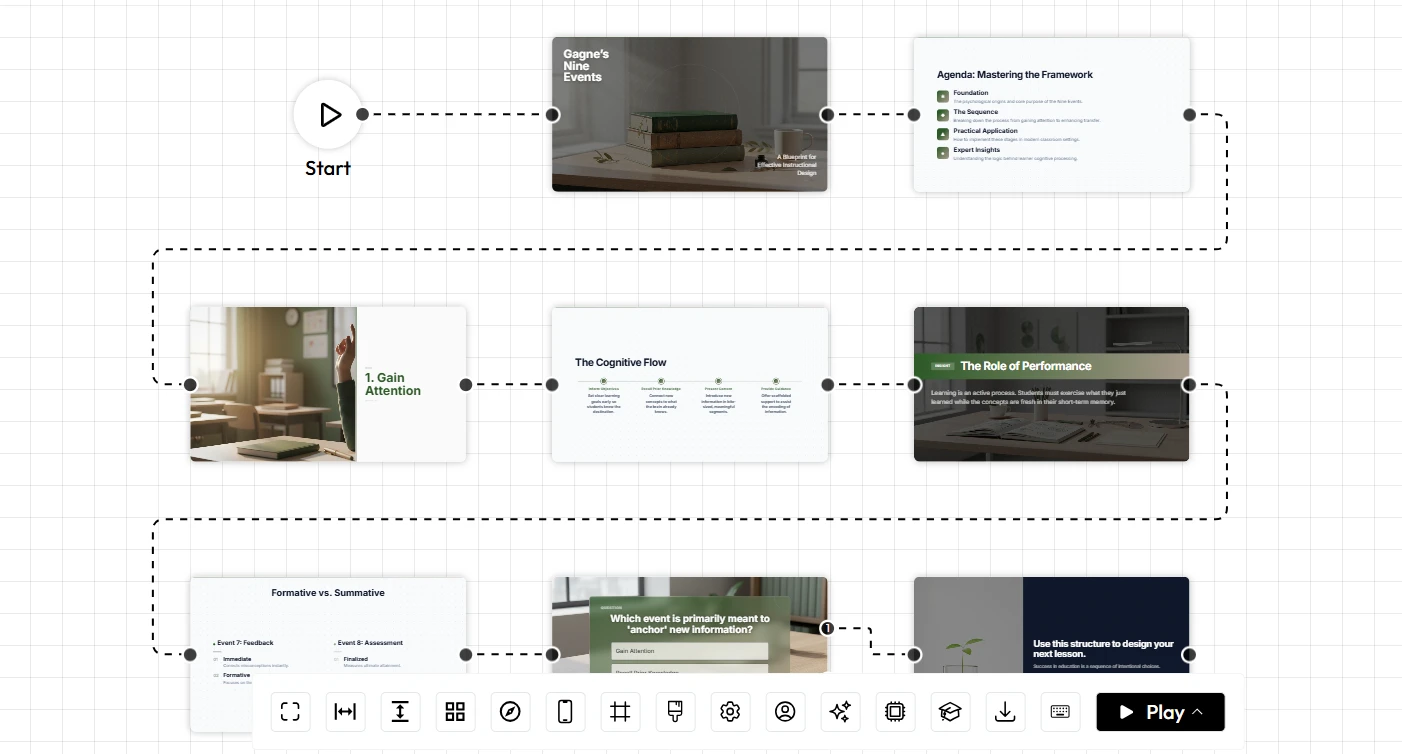
Unni utilizes a node-based visual editor that allows content teams to build complex, non-linear learning experiences. For instance, a professor teaching an introductory course in bioinformatics can map out a lesson that branches based on student understanding. If students struggle with a specific computational concept, the presentation can route them to a supplemental module that offers a deeper explanation and a secondary knowledge check. This level of sophistication, which previously required advanced programming knowledge or expensive custom-built software, is now accessible through intuitive AI interfaces. By using Unni.ai to generate AI slides that adapt to student needs, content teams ensure that lectures remain responsive to the class’s progress rather than being locked into a rigid, predetermined sequence.
Scaling Digital Experience Creation Across Departments
University departments often struggle with internal siloes, where teaching styles and material quality vary widely between professors. Standardizing the quality of digital experience creation across a campus requires a centralized approach to production. An AI presentation generator acts as a platform for this standardization by providing templates and design logic that ensure all materials meet the university’s accessibility and branding guidelines.
When a department adopts Unni, it creates a single source of truth for course assets. Research data, citations, and foundational concepts are stored within the system, allowing faculty to generate high-quality presentations rapidly. This does not mean that every lecture looks the same; rather, it ensures that the structural integrity of the pedagogy is consistent. Because Unni allows for easy modification of AI-generated content, individual professors retain the ability to inject their unique insights and academic voice into the modules. This balance between institutional standardization and individual creative freedom is critical for maintaining academic rigor.
Future-Focused Insights: Supporting Active Learning
The future of higher education lies in the transition from passive lecture-based models to active, inquiry-based learning. Content teams must design materials that invite participation rather than just passive observation. AI slides facilitate this shift by allowing the seamless integration of multimedia, interactive quizzes, and branching scenarios directly into the slide flow.
When an instructor presents a case study in law or medicine, the AI-generated presentation can serve as a platform for live debate. Instead of having students watch a static slide, the professor can use Unni to move through interactive decision points, asking students to vote on the next step of the process. The platform provides immediate feedback, revealing the consequences of different choices. This integration of technology into the lecture hall transforms the learning experience from a unidirectional flow of information into a collaborative investigation. As institutions continue to invest in this type of active learning, the role of content teams will increasingly center on using Unni to build these interactive, intellectually challenging environments.
Frequently Asked Questions (FAQ)
How does an AI presentation generator assist in maintaining academic rigor?
The platform handles the time-intensive tasks of layout and visual structure, allowing faculty and instructional designers to focus their expertise on the accuracy of content, the depth of research, and the quality of citations. It provides a better container for rigorous intellectual discourse.
Can Unni handle complex datasets and research citations?
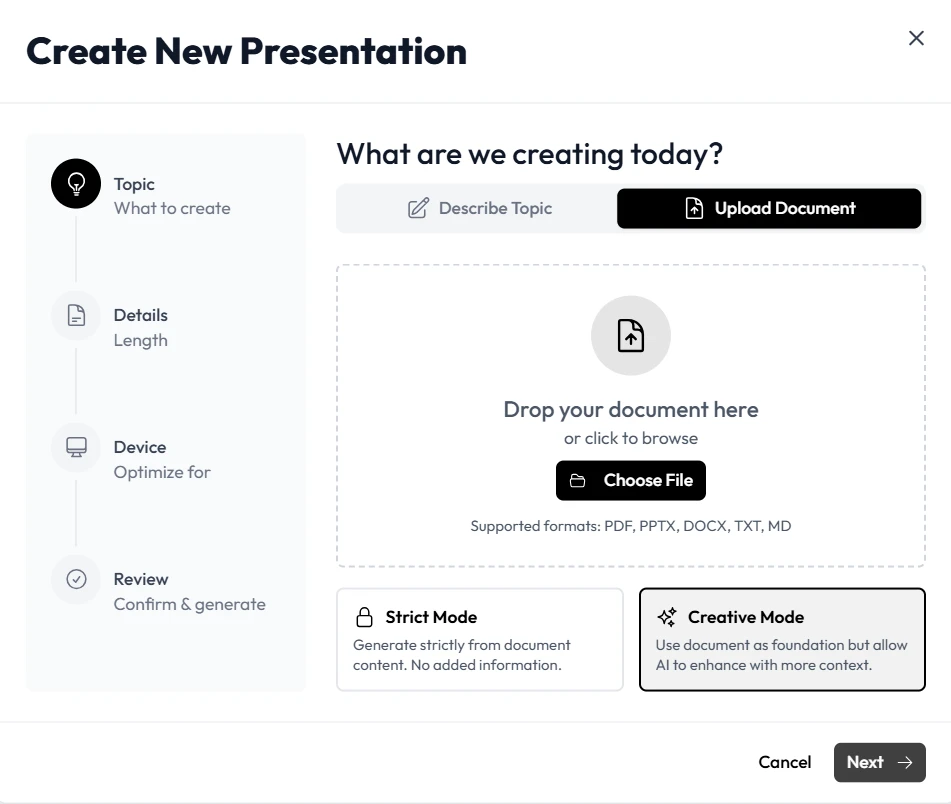
Yes. The system is designed to ingest detailed academic content. Content teams can input research findings and primary source documentation, which the platform then organizes into logically sequenced, visually accessible presentations that adhere to academic standards.
How does presentation automation support accessibility requirements?
AI-driven platforms can automatically apply accessibility best practices, such as proper heading structure, color contrast ratios, and descriptive metadata for images. This ensures that higher education institutions can meet strict compliance requirements for students with diverse learning needs without manual oversight for every slide.
Can we export content generated in Unni to our existing LMS?
Yes. Unni is engineered for interoperability. Course materials can be exported as SCORM packages or high-quality video files, allowing them to be uploaded directly to Learning Management Systems like Canvas, Blackboard, or Moodle, ensuring seamless delivery to students.
Does using educational AI replace the need for instructional designers?
No. It empowers them. By automating the mechanical aspects of slide creation, the tool allows instructional designers to function as high-level pedagogical consultants, focusing on course strategy, learning outcomes, and student engagement tactics rather than formatting.
Conclusion
The integration of advanced technology into higher education is not simply a matter of convenience; it is a pedagogical necessity. By adopting an AI presentation generator, content teams in higher education can liberate themselves from the constraints of manual formatting and instead dedicate their expertise to high-level instructional design. Educational AI provides the structural support needed to create engaging, non-linear curricula that meet the demands of modern learners.
Utilizing AI slides allows universities to maintain their commitment to academic excellence while ensuring that their course materials remain accessible, interactive, and effective. Unni stands as an essential partner for institutions aiming to scale their content creation efforts and secure their place in the future of academic instruction.