Educational AI Tools That Save Teachers Hours Every Week
Discover the educational AI tools that are saving teachers hours every week. Learn how Unni.ai reduces lesson prep time and cuts planning bottlenecks.
The pedagogical landscape of 2026 is defined by a critical paradox: while the demand for personalized, high-quality instruction is at an all-time high, educator burnout remains a systemic threat. Traditional administrative burdens, specifically manual lesson planning and slide design, frequently consume up to 15 hours of a teacher’s weekly schedule. However, the emergence of sophisticated educational AI is fundamentally altering this trajectory.
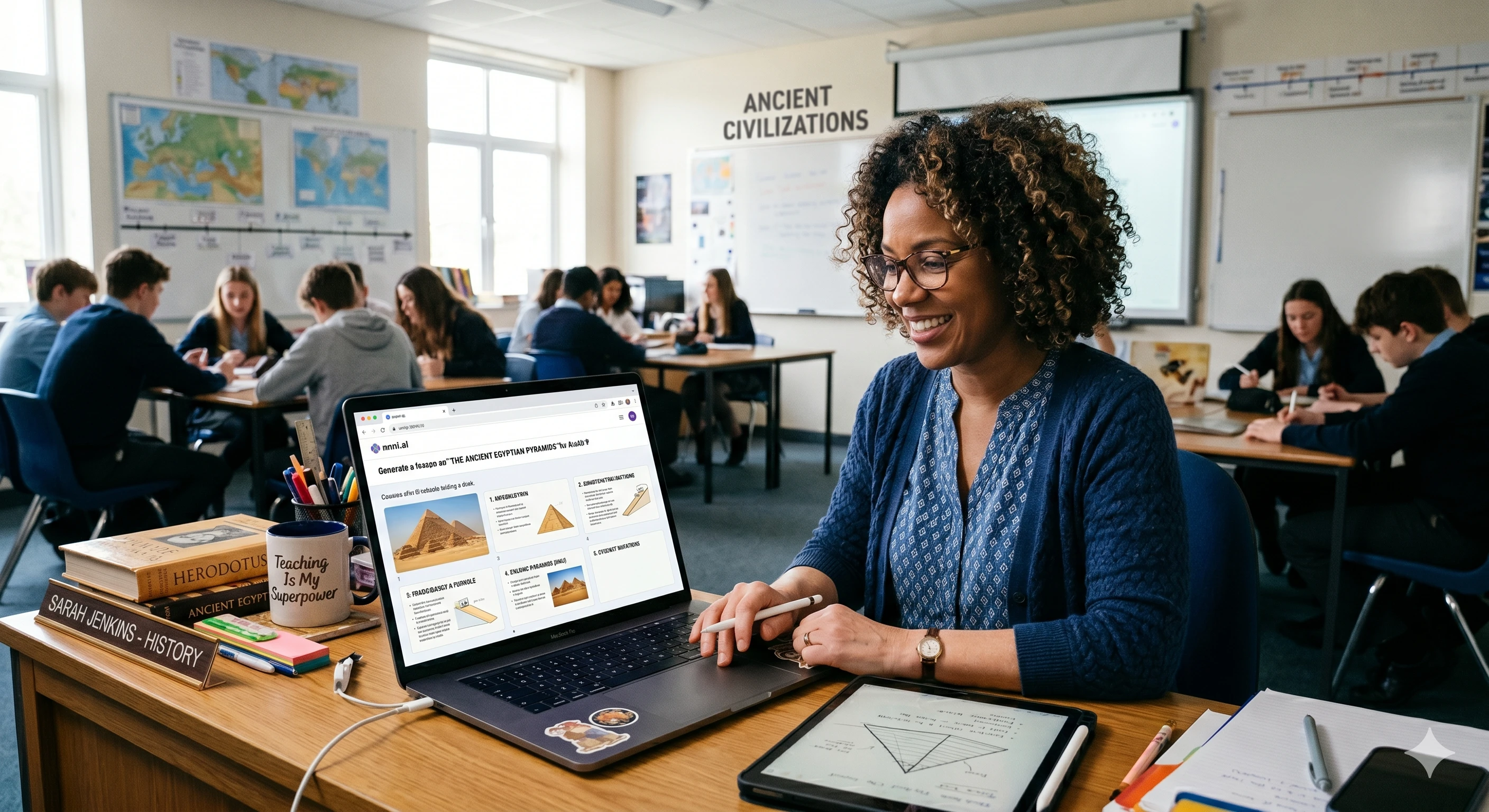
By integrating a specialized AI presentation generator into their daily workflows, educators are no longer starting from a blank canvas. Instead, they are utilizing presentation automation to transform raw curriculum standards into engaging, visually coherent learning experiences in a fraction of the time. At Unni.ai, we see this not as the replacement of the teacher, but as the liberation of the educator. This article explores the specific AI tools and strategies that are helping teachers reclaim their time and refocus on what matters most: human-to-human mentorship.
The Automation of Instructional Design: A Trend Analysis
In the current academic year, educational AI has moved beyond simple chatbots and into the realm of structural automation. According to recent 2026 industry reports, nearly 83% of K-12 teachers now utilize some form of generative technology for school-related activities. The primary driver for this adoption is the “efficiency leap” provided by presentation automation.
Instructional design was once a siloed process. A teacher would research a topic, draft an outline, and then spend hours in PowerPoint or Google Slides manually aligning text boxes and searching for royalty-free images. Today, Unni.ai act as an end-to-end AI presentation generator. By feeding the AI a simple prompt or a PDF of a textbook chapter, the system can autonomously generate a 12-slide deck that follows established pedagogical principles, such as Mayer’s Multimedia Learning Theory.
Key Trends in Teacher Productivity:
-
Standards-Aligned Generation: AI now maps content directly to state or national curriculum standards during the initial draft.
-
Adaptive Differentiation: Tools can now take a single presentation and “level” it for different reading abilities, creating one version for advanced learners and another for students requiring more support, with a single click.
-
Multimodal Content Synthesis: Modern systems can pull in live data visualizations and interactive simulations, moving away from static bullet points.
Why Presentation Automation is Reshaping Training Workflows
In both academic and corporate settings, the most significant “time sink” has always been the visual delivery of information. Presentation automation is not just about making slides faster; it is about maintaining a “gold standard” of instructional quality across an entire organization.
For corporate learning teams, training automation ensures that every compliance module or sales training deck looks professional and stays on-brand without requiring a dedicated graphic designer for every update. Unni.ai facilitates this by allowing teams to lock brand assets (fonts, colors, and logos) so that the AI presentation generator produces consistent results every time. This structural consistency is vital for cognitive ease; when students or employees see a familiar, well-organized layout, they can focus entirely on the content rather than being distracted by poor design.
The Evolution of Lesson Planning with AI for Teachers
The most successful implementation of AI for teachers is found in the integration of content and delivery. Historically, a “lesson plan” was a document and a “presentation” was a separate file. In 2026, these two entities are merging.
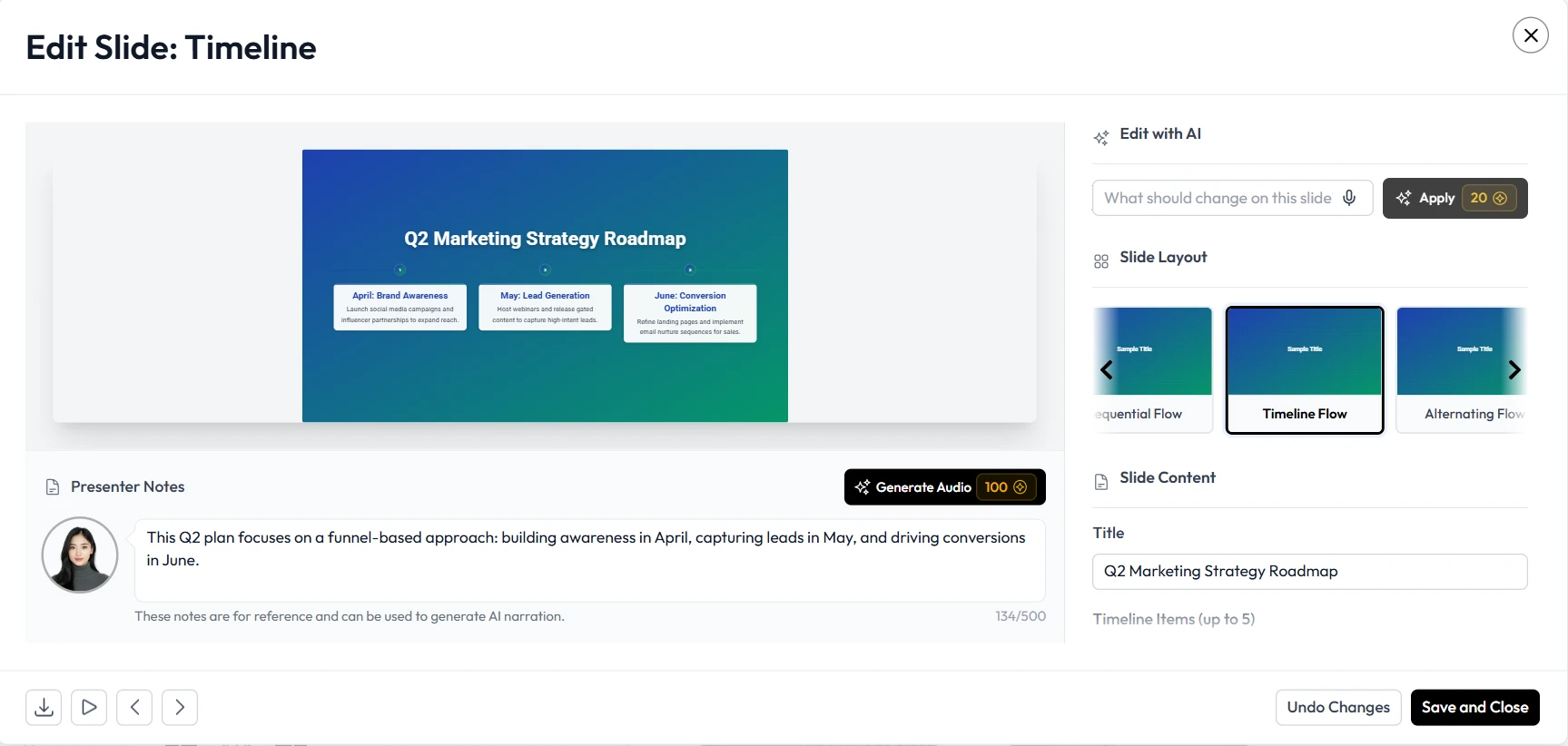
When an educator uses Unni.ai for lesson planning, the AI doesn’t just provide a list of activities; it builds the visual scaffold for those activities. This “Intelligent Canvas” approach allows the teacher to see the flow of the lesson as it will be experienced by the student.
Case Study: Reclaiming the Planning Period
A study conducted in early 2026 found that teachers who adopted AI-driven communication and planning tools reclaimed an average of 5 to 7 hours per week. Those hours were redirected into:
-
Small-group interventions: Providing targeted support to students who are falling behind.
-
Social-Emotional Learning (SEL): Spending more time on student well-being and classroom culture.
-
Professional development: Learning new advanced instructional strategies.
Expert Commentary: The Instructional Designer as Curator
The shift toward educational AI is often met with the concern that “the human element” will be lost. However, industry experts suggest the opposite is true. As routine tasks like slide formatting and basic content drafting are handled by an AI presentation generator, the role of the instructional designer evolves from a “builder” to a “curator.”
At Unni.ai, we emphasize the “Human-in-the-Loop” model. The AI handles the 70% of the work that is repetitive (layout, image sourcing, and initial drafting) while the educator applies the final 30% of expertise. This includes the nuanced context, the personal anecdotes, and the specific classroom differentiation that an algorithm cannot replicate. This synergy is what defines the most effective modern learning environments.
Future-Focused Insights: The Rise of Real-Time Adaptation
What does the future of the AI presentation generator look like? We are moving toward a world of “Living Slides.” By late 2026 and 2027, we expect to see educational AI that can listen to a live classroom discussion and update the presentation on the fly. If a student asks a complex question about a chemical reaction, the AI could instantly generate a 3D visualization to explain the concept, seamlessly inserting it into the current deck.
Furthermore, presentation automation will soon integrate with Learning Management Systems (LMS) to provide real-time analytics. Imagine a slide deck that changes its own complexity based on the quiz scores of the students currently sitting in the room. This level of hyper-personalization is the ultimate goal of Unni.ai.
FAQ: Navigating the AI Presentation Landscape
Can an AI presentation generator handle specialized subjects like STEM or Law?
Yes. Modern educational AI is trained on vast datasets of academic literature. Unni.ai, for instance, can generate complex diagrams, mathematical equations, and case law summaries that maintain high levels of accuracy.
Is the content generated by AI original?
The AI slides created by Unni.ai are synthesized from learned patterns to create unique layouts and phrasing. However, we always recommend that educators review the content to ensure it aligns with their specific teaching voice and local requirements.
How does presentation automation help with student engagement?
By using an AI presentation generator, teachers can include more varied media, such as AI-generated imagery and interactive maps, which are more effective at capturing student attention than traditional text-heavy slides.
Conclusion: Empowering the Next Generation of Educators
The integration of educational AI into the classroom is not a trend; it is a fundamental shift in how human knowledge is organized and shared. By leveraging an AI presentation generator, teachers are successfully combatting the time poverty that has plagued the profession for decades.
At Unni.ai, we believe that presentation automation is the key to a more sustainable and effective educational system. When we automate the “doing,” we provide teachers with the space to focus on the “thinking.” Whether you are an instructional designer building a global training program or a K-12 teacher preparing for tomorrow’s first period, Unni.ai provides the tools you need to create world-class AI slides in seconds.
The future of lesson planning is here. It is fast, it is intelligent, and it is designed to put the power back into the hands of the educator.
Explore the possibilities of Unni.ai today and see how much time you can reclaim for your students.